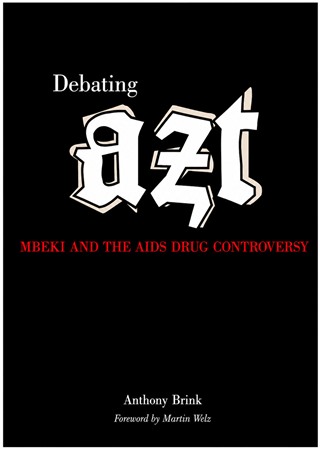
Debating AZT: Mbeki and the AIDS drug controversy
Then subtitled Questions of safety and utility, an early manuscript of this book sent up to Government in May 1999 detonated the South African AIDS controversy when on 28 October 1999 President Thabo Mbeki ordered an enquiry into the safety of the drug.
It was published in November 2000 and sold in bookshops and stocked by public libraries throughout South Africa.
A few paperback copies are still available.
A leaflet Why do President Mbeki and Dr Tshabalala-Msimang warn against the use of ARV drugs like AZT? (PDF) provides a quick updated overview of the subject.
Reviews
the ravings of [a] drivelling conspiracy-theorist, loony, crackpot, fruitcake. ... I'm a professional at spotting weirdos
I do not intend to engage in nonsensical debates on AZT or other AIDS-related matters. I find the issues you raise a total waste of energy but perhaps more exciting for ignorant people in the field. ... Remember that I am the scientist and not you
I am emeritus professor of organic chemistry at UND. I am also a doctor of science of Oxford University, and although I know little about AIDS and less about AZT, I am trained to evaluate scientific argument. Your book on AZT ranks among the biggest tosh that I have ever read, and far the most sustained. I would not think the distinguished people whose approving comments you quote can have read much of it. I have no wish to argue with you, it would be impossible to penetrate your ignorant conceit, I would not wish to criticise your book, it would take too long. I do not know whether your basic claims about AIDS are correct or not, I have not seen the evidence, your book is not evidence, it is a prosecution brief drawn up by an inferior lawyer
you are justified in sounding a warning against the long-term therapeutic use of AZT, or its use in pregnant women, because of its demonstrated toxicity and side effects. Unfortunately, the devastating effects of AZT emerged only after the final level of experiments was well underway ... Your effort is a worthy one. ... I hope you succeed in convincing your government not to make AZT available
He has tracked and digested every important reference to AZT in contemporary medical literature. The result is a comprehensive and alarming review of the findings of medical researchers on the clinical use of the drug. [Based on the research literature he reviews] the argument [against it] is devastatingly clear
It must be said in Mbeki's defence that Brink ... is an able lawyer who argues his case with persuasive force. ... 'That was the first time I became aware of this alternative viewpoint,' Mbeki told me. ... He was able to persuade the country's most experienced investigative journalist, Martin Welz, of the validity of his case, so that Welz not only published a series of ... articles on AIDS in his investigative magazine, Noseweek, but also wrote a rapturous foreword to Brink's book on AZT
'That, 'Mbeki told me, 'is what sparked it off'
Why should a lawyer have to do the work that doctors and scientists ought to be doing?
Christ this is good ... beautifully written ... extremely accomplished ... so much data. Makes the opposition's platitudes look embarrassingly hollow ... Eleni and I think it's really great
No ... you don't [merely review the medical literature], it's the way you write, it's the way you put it ... Anthony knows more about the science of this than all the other AIDS dissidents put together
superb, extremely well researched, analyzed, written. ... I could not have done a better job. ... Are you a scientist or do you collaborate with one? How could you survey so many scientific publications as an attorney? ... Could you publish your article or a variant of it in a medical/scientific journal? It would strengthen our case no end if scientific papers of that quality would come from several sources, not only from Berkeley and Perth. ... I still can't believe he wrote that. He's really a molecular biologist pretending to be a lawyer
Absolutely spectacular ... superb ... the definitive refutation
excellent ... the best, most comprehensive review on AZT currently available
Anthony Brink is a man of many parts: magistrate or barrister by day, musician by night ... prose stylist. Above all, dedicated and fearless. ... his book ... is clear and crisp and his technical mastery most impressive
outstanding ... top dollar writing
Deserves serious treatment. More strength to your arm
Very good. Convinced me completely
Absolutely amazing ... a work of genius ... he writes really well ... I just love his one-liners
very nice writing ... you can't really be a lawyer ... I love the parallels with other past failed medical panaceas – calomel etc
A hefty blow for free speech and against the strictures of dogma ... Crisp. Logical. Sometimes over the top. Bristlingly intelligent. Exhausting. Acerbic. Sometimes vicious. For anyone who wants to know what Mbeki's on about, it's all here, in a nutshell
an outstanding piece of work ... enormously entertaining ... expert, trenchant devastation of AZT apologists
great ... very important
mind-blowing
extremely courageous ... I thought I was beyond shockability but [Brink's] revelations were stupefying. I think the marketing of AZT to pregnant women is an obscenity
wonderful ... soldier on!
[AZT: A Medicine from Hell, the essay opening the book] is a well written, lucid article for anybody to read. ... your arguments about prescribing this drug are excellent. ... Perhaps when more people like yourself who are not scientists come out publicly to clarify the issue on this drug, pregnant women will be spared! Your article will now be additional prescribed reading for the students in my class
What a good comprehensive review of the literature you performed! ... During my research I noticed a lot of resistance from many different people to believe our data. In general there is resistance to the 'bad news'
amazing
a masterful piece
a rare combination of incisive insight, entertaining wit, profound perspicacity, all of which and a lot more being available through his racy, delicious pen. He exhibits the uncommon gift of a timely turn of phrase that truly adds spice to the intellectual content. ... Mr Brink's book will have an Illichean impact likely to cure the increasingly sick HIV-AIDS establishment in particular and the medical and governmental establishments in general. His exposé is both a diagnosis and a cure. ... [It] will remain a classic eye-opener to the misdeeds of modern medicine for decades to come. I am also sure that Mr Illich will give his imprimatur to Mr Brink at first reading
I started reading it the day it arrived, found it so fascinating that I ... read it through to the end that evening. A case of not being able to put it down. Remarkable research and brilliant writing
Every South African should read it. ... I couldn't put it down
It reads like a thriller, pulling you in ... like a bebop solo, every line packed with information
I laughed and I cried, I laughed and I cried
I read it at work pinned between my desk and my knees and laughed until the tears rolled down my cheeks
Riveting ... [The] style is very funny; it's a shame the subject-matter is so serious... Perhaps, after all, Thabo Mbeki is a visionary, not the fiddling fool he's made out to be ... [If you are] wondering what all the fuss is about, you will not find a more forceful or persuasive explanation ... than in this book. ... meticulously referenced, Debating AZT rattles the not-so-dusty medical skeletons of thalidomide, arsenic and mercury salts. It is a remorseless denunciation of the first and most widely used anti-HIV drug
English translation
Humour can sometimes be a political act of the utmost seriousness. Nothing is more dangerous than making untouchable people and institutions look ridiculous. ... Be warned, the book has a strange effect on the reader. On one hand, it places something unbearably heavy, actually grotesque, on your shoulders, something you can't shrug off with integrity. On the other hand, don't be surprised if a smile creeps over your lips every time you hear the words 'AIDS expert'. ... The cherry on the cake, making Debating AZT a masterpiece, is the humour permeating every line and the spaces between them. ... Brink's style – the interplay of light-hearted humour and deadly seriousness – strongly reminds me of the prophetic literature of the Bible. ... Anthony Brink is not afraid of lawsuits. He writes in the style of gripping fiction. The book breaks taboos, not primarily because it tackles the taboo-laden subject of AIDS in South Africa, but also and especially because it disregards every conventional genre boundary. According to the anthropologist Mary Douglas, taboos concern phenomena threatening to disrupt established systems of classification. In that sense, the author of this book is himself a taboo phenomenon: an advocate from KwaZulu-Natal who insouciantly ventures into the sacred theoretical field of medical science. ... I cannot recommend Debating AZT highly enough – whether you are looking for a literary experience, fascinating history, a deeper understanding of the AIDS controversy, theological or philosophical reflections, or just a good laugh. If I were the Pope (or a leading AIDS researcher), I would stamp this book with my seal of approval: nihil obstat. It is written. No one will ever be able to say: 'I didn't know.'
Humor kan soms 'n politieke daad van die ernstigste aard wees. Niks is gevaarliker as om onaantasbare persone en instansies belaglik te maak nie. ... Wees gewaarsku – die boek het 'n vreemde uitwerking op die leser. Enersyds laai dit iets ondraaglik swaar – grotesk eintlik – op jou skouers, iets waarvan jy nie meer met integriteit kan afkom nie. Andersyds moet jy nie verbaas wees as daar na dese 'n glimlag aan jou lippe kom pluk elke keer as jy die woord 'AIDS expert' hoor nie. ... Die kersie op die koek – wat van Debating AZT 'n meesterstuk maak – is die humor waarvan elke reël, asook die spasies tussenin, deurtrek is. ... Brink se styl – die samespel van ligsinnige humor en dodelike erns – laat my byvoorbeeld onwillekeurig dink aan die profetiese literatuur in die Bybel. ... Anthony Brink deins nie terug vir 'lawsuits' nie. Hy [skryf] in die styl van meeslepende fiksie. Die boek is 'n taboebreker – nie in die eerste plek omdat dit die taboe-gelaaide tema van VIGS in Suid-Afrika aanvat nie – maar ook en veral omdat dit alle genre-matige grense verontagsaam. Volgens die antropoloog Mary Douglas het taboe te make met verskynsels wat dreig om gevestigde klassifikasieskemas te ontwrig. Ook die outeur van hierdie boek is in dié sin 'n taboeverskynsel: 'n advokaat uit KwaZulu-Natal wat met innemende hubris die heilige teoretiese grond van die mediese wetenskap betree. ... Ek kan nie Debating AZT sterk genoeg aanbeveel nie – of jy nou 'n literêre ervaring wil hê, boeiende geskiedenis wil lees, meer te wete wil kom oor die VIGS-polemiek, tot teologiese en filosofiese besinning gebring wil word, of sommer net lekker wil lag. As ek die pous was (of 'n leidende VIGS-navorser) sou ek die stempel van goedkeuring op hierdie boek aangebring het: nihil obstat. Dit staan geskrywe. Niemand sal ooit kan sê: 'Ek het nie geweet nie'
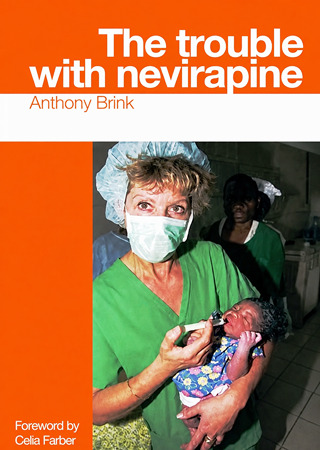
The trouble with nevirapine
The trouble with nevirapine was published in paperback in September 2008 and sold at Clarke's Books in Cape Town.
The book is outlined on its back cover.

Robert Kennedy Jnr. cited it eight times as his source for the nevirapine chapter of his #1 bestseller in 2021 (1.4 million copies sold by August 2026), The Real Anthony Fauci.
Reviews
an amazing job ... brilliantly dissects an avoidable tragedy: how misconceptions and misunderstandings about a new medicine ... caused a pointless, costly and toxic mess that still needs clearing up. An important story with lessons for all of us – and readable with it
an expertly written piece about this very dangerous drug
Brink's meticulously researched ... detailed exposé on the controversial AIDS drug ... reads like a sophisticated crime novel and is full of harrowing facts you won't find anywhere else
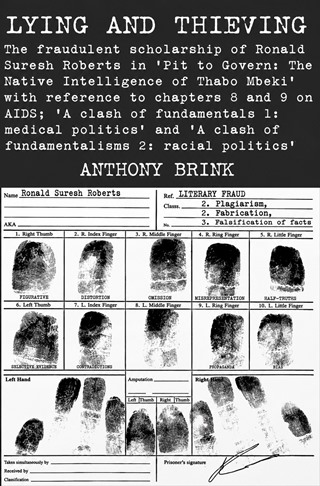
Lying and Thieving: The fraudulent scholarship of Ronald Suresh Roberts
Lying and Thieving: The fraudulent scholarship of Ronald Suresh Roberts in Fit to Govern: The Native Intelligence of Thabo Mbeki, with reference to chapters 8 and 9 on AIDS, 'A clash of fundamentalisms 1: medical politics' and 'A clash of fundamentalisms 2: racial politics' is summed up on its back cover:
This critical analysis of chapters 8 and 9 of Fit to Govern: The Native Intelligence of Thabo Mbeki (Johannesburg: STE, 2007) demonstrates Ronald Suresh Roberts to be an extensive plagiarist, a fabricator and falsifier of history, and the author of a colossal literary fraud, and accordingly so grossly unprofessional and discreditable a writer that he's unfit to be relied upon for any purpose, not even for directions to the post office.
And after reading Lying and Thieving in horror right after its release in November 2007 – free online in PDF and sold in paperback at Clarke's Books in Cape Town – both the publisher and editor of Fit to Govern agreed: STE Publishers cancelled the second impression then about to go to press, and the English historian and journalist James Sanders PhD denounced the book he'd just edited as:
the most serious case of plagiarism and literary fraud in South African literary history
Discussing Lying and Thieving with Brink over lunch in Cape Town, Daily Maverick editor Branko Brkic marvelled at its
amazing detail!
And exclaimed:
Everyone in Joburg's read it!
Sunday Times columnist Fred Khumalo quoted one Pat Stevens:
On every coffee table in the land, a book passed on from hand to hand. The type of book that makes you think, until the strike from tree snake Brink! Lying and Thieving poisonous fink, who was the venom of tree snake Brink. ... Flagrant liar and cowardly bully, fraudulent scholarship and rather silly. ... Ronald Sure is Rubbished.
The book was a sensation in all the newspapers, popping off with no less than four (4) separate articles about it in the same edition of the Sunday Times in the week it was released, plus a prominent flag at the top of page 2 calling attention to the scandal. Business Day's weekly, The Weekender, splashed Roberts' plagiarism on its front-page in a headline article.
Mark Gevisser told us at a talk about his biography Thabo Mbeki: The Dream Deferred in Sea Point, Cape Town, on 20 May 2008 that Mbeki had written to him after his book came out specifically to confirm that he'd been right to describe him as an AIDS dissident, adding that if he'd just look at the evidence he'd be one too.
That is, Mbeki expressly repudiated the brazen lie Roberts had told his readers at the start of the first of his two AIDS chapters in Fit to Govern, published in June 2007, a few months before Gevisser's Mbeki biography in November: 'Thabo Mbeki is not now, nor has he ever been, an AIDS dissident.'
The expanded January 2008 edition of Lying and Thieving included a new Introduction and five additional chapters:
Mbeki's Castro Hlongwane bombshell
More evidence of Roberts's plagiarism turned up and the editor of Fit to Govern, Dr James Sanders, agrees
The mind of a rogue at work: Roberts's developing denigration of Brink in Fit to Govern from draft to draft
Roberts's responses to the charges in Lying and Thieving
How Roberts wrote Fit to Govern to order, chopping and changing his manuscript on Essop Pahad's secret instructions, and prostituting his 'intellectual independence' to mining capital
The expanded edition discusses Gevisser's report in his November 2007 biography (released just after Lying and Thieving was published earlier in the same month) that after Roberts's Fit to Govern came out in June, Mbeki responded to Roberts's gross misrepresention of his views on AIDS and acted to correct the record that Roberts had fouled by telephoning Gevisser to ask him if he'd read his Castro Hlongwane paper, which he'd originally drawn for discussion by the ANC NEC at its April 2002 meeting, right after which he had his driver deliver Gevisser a hardcopy in much amplified form. (Thanks to Gevisser for scanning that extended version of Castro Hlongwane for Brink and emailing it over.) In that meticulously referenced, tightly reasoned scholarly monograph, Mbeki unambiguously set out his actual dissentient position in the AIDS controversy, and made absolutely clear that Roberts's claim in his June 2007 book that he was still with the believers was perfectly false. Quite the contrary, as Gevisser correctly stated in his book: 'There is no question as to the message Thabo Mbeki was delivering to me along with this document: he was now, as he had been since 1999, an Aids dissident.' Just as Brink showed irrefragably in Lying and Thieving.
Zapiro found Brink's plagiarism charges a joke:

But not Politicsweb editor James Myburgh, who performed a comparitive textual analysis and reported numerous clear-cut instances of Roberts's theft of Brink's work – and the Press Council agreed. (See the similar, subsequent Jason Arday case.)
The November 2008 reprint of Lying and Thieving included an Endnote with five updates.
The book's footnotes are online.
Brink's letter to Harvard Law Professor Alan Dershowitz, Birds of a Feather (PDF), summed the book up and traced the many unpleasant parallels between the Roberts/Brink and Dershowitz/Finkelstein affairs:
Fine letter and very appropriate
Thanks ... A thumbs up from Chomsky is the best way to start the day

Introducing AZT: 'A World of Antiretroviral Experience'
Introducing AZT is a sequel to Debating AZT and includes research findings reported after it was published.
It's outlined by its back cover blurb:
What do George Bush, Barack Obama, Desmond Tutu, Edwin Cameron, Tony Leon, Barbara Hogan, Baleka Mbete, Charlene Smith, Patrick Bond, Anton Harber, Nicoli Nattrass, Ferial Haffajee, Maureen Isaacson, Kerry Cullinan, Zackie Achmat, Mark Heywood, Nathan Geffen and even Nelson Mandela have in common?
All say AZT and similar ARV drugs save lives, especially little babies' lives. And they really believe this from the bottom of their hearts.
Why, this is what South African Professors William Makgoba, Jerry Coovadia, Glenda Gray, Salim Karim, Robin Wood and Gary Maartens claim, along with Doctors Francois Venter, Ashraf Grimwood and Kgosi Letlape.
But what do the world's top HIV experts, Professors Luc Montagnier, Robert Gallo, Jay Levy and Robin Weiss reckon about AZT?
What do the studies find, particularly the biggest study on the efficacy of ARVs yet conducted?
What most unpleasant things happened to Zackie Achmat when he briefly tried these drugs out himself, and why?
What's the horrible effect of AZT on unborn and newly born African children?
And what does the scientist who invented AZT as a cell poison in 1961, Richard Beltz, have to say about it all?
Find out in Introducing AZT.
Get ready for 'A world of antiretroviral experience'.
The book has no author narrative, and lets the drug's champions and critics contend for and against the drug themselves.
Included in the appendices are:
Inventing AZT (PDF), the scoop story related to Brink by the biochemist Professor Richard Beltz who first synthesized the drug, telling how he invented it as a cell poison and reporting how he changed his mind about its use during pregnancy after reading the foetal toxicity literature that Brink reviewed in Debating AZT.
Licensing AZT (PDF) recounts the utterly fraudulent manner in which the drug was approved by the American Food and Drug Administration.
Do the drug manufacturers themselves say their ARV drugs save lives or help people live longer?
Publication of the final manuscript in paperback was held up by distracting circumstances, and the completed book with its cover designed and ISBN number obtained never made it to print.
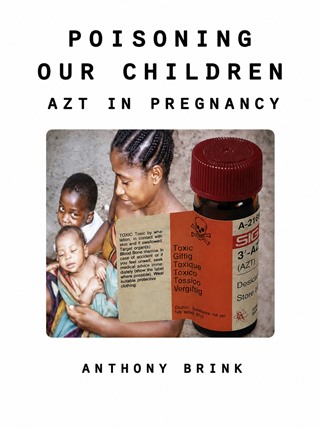
Poisoning our Children: AZT in pregnancy
Poisoning our Children: AZT in pregnancy is a compendium of letters to the Medicines Control Council exhaustively reviewing the foetal and neonatal toxicity literature on AZT. The Endnotes tell how Mbeki's and his Health Minister's worst apprehensions were realised, anticipated by the October 2008 TIG press statement (PDF), On the 50th anniversary of the thalidomide disaster, another tragedy of countless children killed and maimed foretold, and a final letter to the Health Minister concerning AZT in pregnancy (PDF), both included in the appendices.
An 8-page leaflet Why do Zackie Achmat, Nathan Geffen and Mark Heywood want pregnant African women and their newborn babies given AZT? What AZT does to unborn and newly born children (PDF) provides essential information about this horror.
Review
Clearly your knowledge-base in this subject extends far beyond ours
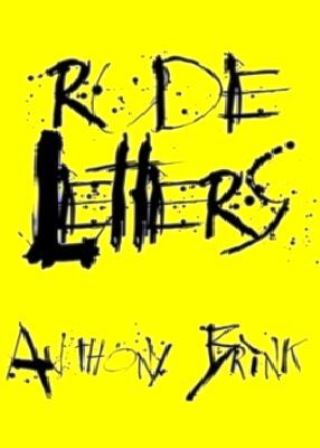
RUDE LETTERS
The back cover will tell you what RUDE LETTERS is all about: a collection of ironic letters to the AIDS experts and other AIDS promoters in South Africa, asking them a whole lot of foolish questions – only, maybe not so foolish.

Another unrealised book project: cover designed, ISBN number obtained, but interrupted and not published in paperback.

Draft Bill of Indictment against Zackie Achmat on a Charge of Genocide in the International Criminal Court at The Hague
This criminal complaint against Treatment Action Campaign leader Zackie Achmat was physically delivered to the office of the ICC's Chief Prosecutor at The Hague in January 2007, and acknowledged the same month.
ChatGPT, Grok, and DeepSeek all returned amazingly perceptive, accurate, deep analyses of the rhetorical, polemical, satirical and ironical devices used in the complaint.
Reviews
Political journalist Terry Michael in Washington found it:
side-splittingly funny. If the TAC founder weren't so deadly serious, he would qualify as a clueless buffoon in a TV comedy
But veteran AIDS journalist Celia Farber in New York didn't think it amusing at all:
I have read the complaint carefully, twice. Despite my 20 year immersion in the mind-reeling odyssey of the HIV Drugging Wars, I was disoriented, shocked, and wounded from this. It is so psychologically, politically, morally, and bio-chemically bizarre that one feels crazy from it. ... It builds calmly at first, then turns increasingly merciless, like the sealing bricks at the end of Poe's The Cask of Amontillado
One American reader reported:
The complaint you filed with the ICC in The Hague remains one of my favorite works in the English language. ... [It] has always been a wonderful enigma, dripping with surreal irony yet so devoid of sarcasm that I could never categorize it as purely satirical. To me it was more Dante than Swift, and much of the genius (and horror!) lay in the fact that a literal reading not only worked, but seemed the most just. Whether it was actually an admissible legal document, I still don't know. Celia's comparison to The Cask of Amontillado was, um, apropoe (sorry)
On the other hand, an attorney I know angrily complained that in drawing and filing it I'd:
gone too far
– but didn't the English painter Francis Bacon observe: 'Only by going too far can you go far enough'?
The July 2007 issue of Molotov Cocktail denounced it as:
hysterical fascist nonsense [by] swivel-eyed Brink ... more than a few sandwiches short of a picnic
(The editor changed his mind soon afterwards and became a friend and ally.)
The Cape Argus billed it purse-lipped on street-poles as:
BIZARRE CHARGE AGAINST ZACKIE
And published the TAC's view of it:
A TAC spokesperson described the complaint as 'the rantings and ravings of a madman' ... Almost every single quotation in his report was out of context ... [It was] rubbish beginning to end ... truly delusional ... laughable
In a press statement:
The Treatment Action Campaign would like to inform the public and the media that it refuses to waste public resources in dignifying Anthony Brink's lunatic call for the International Criminal Court to prosecute its chairperson Zackie Achmat. Anthony Brink's actions serve only to insult the rationality of all sane people and the difficult experiences of millions of people who live with HIV/AIDS in the world. We therefore ask that the media not to call our organization for comment on this as this is our official comment
London Guardian medical journalist Dr Ben Goldacre scowled in an editorial on 13 September 2008 that the complaint went to:
the heights of surreality
And described it in his regular column in that paper a week later as:
A new all-time low [in] South Africa, where President Thabo Mbeki has a long history of siding with the HIV denialists, who believe that HIV does not cause Aids (but that treatments for it do) [namely] Anthony Brink ... the man who is credited with introducing Mbeki to HIV denialism, who has helped cost the lives of tens of thousands of people needlessly deprived of effective treatments. [The complaint was] ridiculous ... vicious and unhinged hatred ... full-on fruitcake action... . This is supposed to be a serious war crimes document, remember
Goldacre frothed some more in the June 2009 edition of WIRED:
After a litany of horrors, we come to the most challenging point of the story. In 2007, to great media coverage, ... Brink filed a formal complaint against Zackie Achmat at the International Criminal Court in the Hague, accusing him of genocide for successfully campaigning to gain access to HIV drugs for all South Africans
Also missing the irony, a German friend thought it:
sadistic
On the other hand, an African fan said he'd read bits out to his mates and had them all rolling about laughing. As did a Dutch guy; but then it's been said that the Dutch have 'an endless appetite for venom served with a wink'.
So was it serious? Was it a joke? Was it a serious joke –
an elaborate spoof
as one reader put it? A political prank, a stunt in Propaganda of the Deed as the anarchists used to say?
AIDS promoter Chris Noble thought so:
Brink has done this as a carefully calculated publicity stunt. ... I suspect that Brink knows full well that his submission will be used for toilet paper. He doesn't care. He got the publicity he wanted. He got his name in several papers and he got interviewed on several radio stations
Very true! This included interviews by three national radio stations prime-time, and by innumerable regional and community stations.
Read it and decide for yourself. You may conclude like the TAC's Mark Heywood did, moaning about the complaint on the radio, that I wanted his pal Achmat
tortured
Or, being a brighter sort of person, you may read the complaint as a parody of a formal criminal arraignment, a satirical attack on Western political show trials generally, set in high formal legal language, but cut with mounting black humour, parodying the TAC's own repeated abuse of the courts to advance their drug-shilling agenda, and exposing Achmat's stupidity and ignorance, his dishonesty and hypocrisy, as it pleads the dismal facts with blistering sarcasm, on the way providing an informative introduction to what ARV drugs do to people, including and especially to Achmat himself. Turning a carving knife in his stomach as it does so. With a smile.
The best historical precedent in style and purpose is Daniel Defoe's The Shortest Way with the Dissenters; Or, Proposals for the Establishment of the Church in 1702, convincingly advocating the extermination of his own party ('Crucify the Thieves!') to ridicule political and religious intolerance; but which he also found necessary to explain after his gulled opponents were taken in, enraged when they realised they had been mocked, and had Defoe arrested, fined, and pilloried for three days. A more immediately obvious satire is Jonathan Swift's A Modest Proposal for Preventing the Children of Poor People From Being a Burthen to Their Parents or Country, and for Making Them Beneficial to the Publick: his proposal in 1729 that the excess of Irish children be served on English dinner plates to alleviate the meat shortage – to point up the cruelty of English colonial policy in Ireland.
Here's the original A4 format version (PDF).
It's been translated into Russian, Spanish, Italian, French, German and Dutch.
Treatment Action Campaign and South African Medical Association v Anthony Brink, Treatment Information Group, and Others: Answering Affidavit
This provocative answering affidavit was filed in the Cape High Court in mid-2007, knocking the TAC and its laughable case to pieces. And sending the TAC running for the hills: here's the happy ending (PDF) in March 2008, three days after heads of argument (PDF) were filed. The affidavit was contrived to inform and answer, but with a subversive bang – as in the 'rupture defence' strategy of radical French avocat Jacques Vergés.
The affidavit in its original A4 format (PDF) is hyperlinked to its annexures.

'Just say yes, Mr President': Mbeki and AIDS
'Just say yes, Mr President': Mbeki and AIDS is Brink's major work in progress, his magnum opus, his long delayed, substantially complete but unfinished 'symphony for three orchestras': a comprehensive +1000-page history of the South African AIDS controversy, and an interrogation and deconstruction of its medical and ideological foundations.
Outlined on its back cover, the book is more fully described in a prospectus (PDF) that includes a review of all prior biographies and political histories and their failure to get to grips with and explore Mbeki's thinking on AIDS. About half of it comprises a close analysis of how and why Mark Gevisser screwed up his AIDS chapter in Thabo Mbeki: The Dream Deferred even as Mbeki went out of his way to help him get it right.
'For very great is the number of the stupid' – as Galileo observed very correctly – is a collection of public statements about Mbeki and Brink by their foes on AIDS to appear in the prefatory pages of the book.
Reviews
This book is a pit bull ... a tour de force ... a brilliant and searing polemic ... incandescent ... You write so well
An outstanding interdisciplinary study pivotal to understanding Mbeki's stance on AIDS. My respect for his integrity in the face of Western economic and ideological agendas has been deepened. One is reminded that all one knows is learned, but not necessarily true....
Brilliant, fucking brilliant ... [its] Swiftian, acid wit [is] very funny, it made me laugh out loud ... I can't help it [aping its distinctive prose style], your writing's infectious ... very good, very important ... maybe I should write the foreword
English translation
Absolutely breathtaking ... a gripping analysis of the ideological, religious, commercial and cultural foundations of one of the defining phenomena of our age, namely AIDS. ... [Brink is] one of the most interesting thinkers I have ever met
Absolutely breathtaking ... 'n aangrypende ontleding van die ideologiese, religieuse, kommersiële en kulturele onderbou van 'n definierende verskynsel van ons tyd, naamlik VIGS. ... [Brink is] een van die interessantste denkers wat ek nog ontmoet het
English translation
Anthony Brink provides not only a comprehensive chronicle of the turbulent history of AIDS in South Africa to date, but does so with precisely the scepticism such an undertaking demands. The result is a relentless dismantling of the credibility of the AIDS industry in South Africa and around the world: alarming AIDS statistics, the celebrated virtues of AIDS drugs, the reliability of AIDS tests, the supposed causal role of 'HIV', even the unquestioned existence of the latter – all come under fire in a way that leaves the reader breathless. But Brink digs even deeper by showing why the scientific arguments (which he sets out masterfully) cannot ultimately decide the AIDS debate. The reason? An ideology presenting itself as 'liberal', but in reality betraying a deeply rooted racism, according to which Africa cannot survive unless white people and their interests prevail. Brink is therefore not merely a scientific commentator, but also a social critic and political analyst of exceptional insight, writing in a style that will delight even the literary connoisseur. The book is packed with humour, yet at the same time is shocking and disturbing because it thoroughly slaughters sacred cows and equips more than a few AIDS saints with conspicuous horns. I cannot recommend Just say yes, Mr President highly enough. It is a worthy successor to his previous masterpiece, Debating AZT, which by comparison was little more than a warm-up. May this book receive the attention it deserves and provoke exactly the outrage it sets out to arouse.
Anthony Brink bied nie net 'n volledige kroniek van 'vigs' se bewoë geskiedenis in Suid-Afrika tot dusver nie, maar doen dit ook met die agterdog wat so 'n onderneming by uitstek vereis. Die resultaat is 'n meedoënlose aftakeling van die geloofwaardigheid van die vigs-industrie in Suid-Afrika en wêreldwyd: skrikwekkende vigs-statistieke, die besonge deugde van vigs-middels, die betroubaarheid van vigs-toetse, die veronderstelde oorsaaklike rol van 'MIV', selfs die vanselfsprekende bestaan van laasgenoemde – dit alles kom onder vuur op 'n manier wat die leser se asem wegslaan. Maar Brink grawe nog dieper deurdat hy aantoon hoekom die wetenskaplike argumente (wat hy meesterlik uiteensit) uiteindelik nie die deurslag in die vigsdebat kan gee nie. Die rede? 'n Ideologie wat sigself as 'liberaal' voordoen, maar in werklikheid 'n diepliggende rassisme verraai waarvolgens Afrika nie anders kan as om onder te gaan as witmense en hul belange nie die botoon voer nie. Brink speel dus nie net wetenskaplike nie, maar ook sosiale kritikus en politieke ontleder op 'n uiters skerpsinnige manier en in 'n styl wat ook vir die literêre fynproewer plesier verskaf. Die boek is propvol humor, maar terselfdertyd skokkend en ontstellend omdat dit heilige koeie behoorlik slag en 'n hele paar vigs-heiliges van opvallende horings voorsien. Ek kan Just say yes, Mr President nie sterk genoeg aanbeveel nie. Dit is 'n waardige opvolg op sy vorige meesterstuk, Debating AZT, wat in vergelyking hiermee nie veel meer as 'n oefenlopie is nie. Mag hierdie boek die aandag kry wat dit verdien en die verontwaardiging uitlok waarop dit uit is